
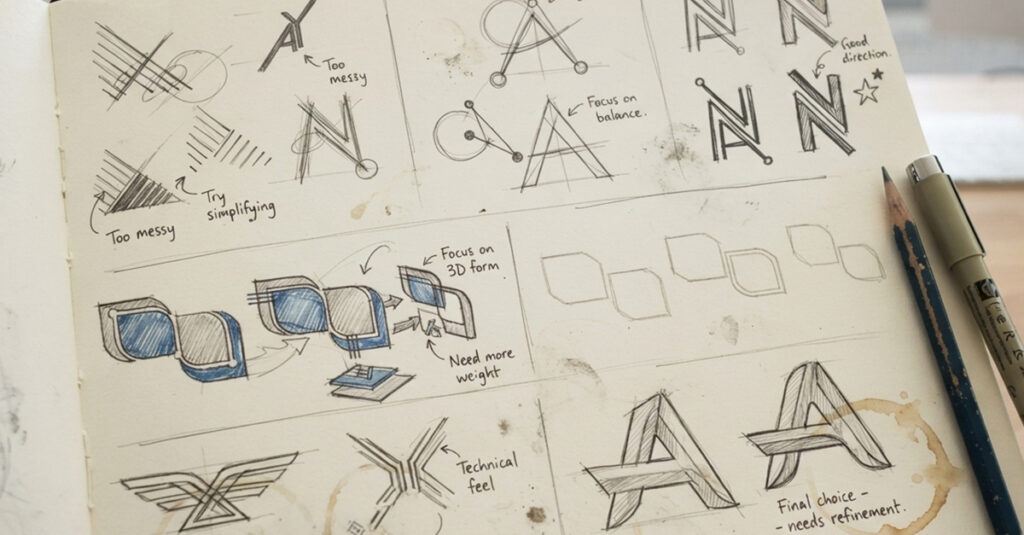
Some of my favorite concepts have never been chosen by a client. Likewise, some of the designs that resonated most with a client weren’t the ones I would have selected myself. That has never bothered me because the goal isn’t to create my ideal design, although it’s always rewarding when those two happen to align. My job is to create work that my client loves, that achieves their goals, and ultimately delivers results.
Whether I’m working with a freelance client or designing in-house for an established brand, every project starts with understanding the objective. With freelance clients, that often means learning about their business, their audience, and the feeling they want their brand to convey. In-house, there may already be brand guidelines and years of established visual identity, but every project still has its own goals, audience, and challenges. Before I ever open Illustrator or Photoshop, I need to understand what success looks like.
From there, I start brainstorming and exploring different directions. I intentionally create concepts that are distinct from one another because I don’t expect the first round to be the final version. The goal is to narrow down the direction and discover what resonates.
That’s where feedback becomes invaluable. The more specific the feedback, the stronger the next round will be. Does the client prefer the font from one concept but the colors from another? Does the design feel too corporate, too playful, too detailed, or not modern enough? Are they drawn to geometric shapes, handwritten fonts, or a particular color palette? Even when none of the concepts land, reference examples help me understand the client’s taste and the direction they’d like to explore. Not to be copied, but as another tool to help me understand the style, personality, and visual language that resonates with them. The more detail a client provides, the more intentional the next iteration becomes.
Taste is subjective, and I don’t expect everyone to share mine. Personally, I gravitate toward blues and cooler color palettes, while someone else may love warm tones, reds, or golds. Neither is wrong. That’s why I never take constructive criticism personally. Feedback isn’t about proving whether my original concept was right or wrong. It’s about understanding someone else’s perspective and using that insight to create the strongest possible solution for them.
The best design projects aren’t built on a single brilliant idea. They’re built through collaboration. Every round of thoughtful feedback refines the work, brings the vision into sharper focus, and gets us one step closer to a design that truly accomplishes its purpose.